01
Intake Gateway
Configured intake channels enter one governed queue with source provenance and a human review boundary.

EEG orders arrive by fax, email, upload, or interface. OrderFlow reads them, your team reviews and approves every one, and technologists, supervisors, and directors work the day from one live, audited tracker.
Orders arrive. Staff validate exceptions instead of retyping patient orders. Leaders can act before workflow gaps become operational breakdowns.
A product of Axiom Neurophysiology.
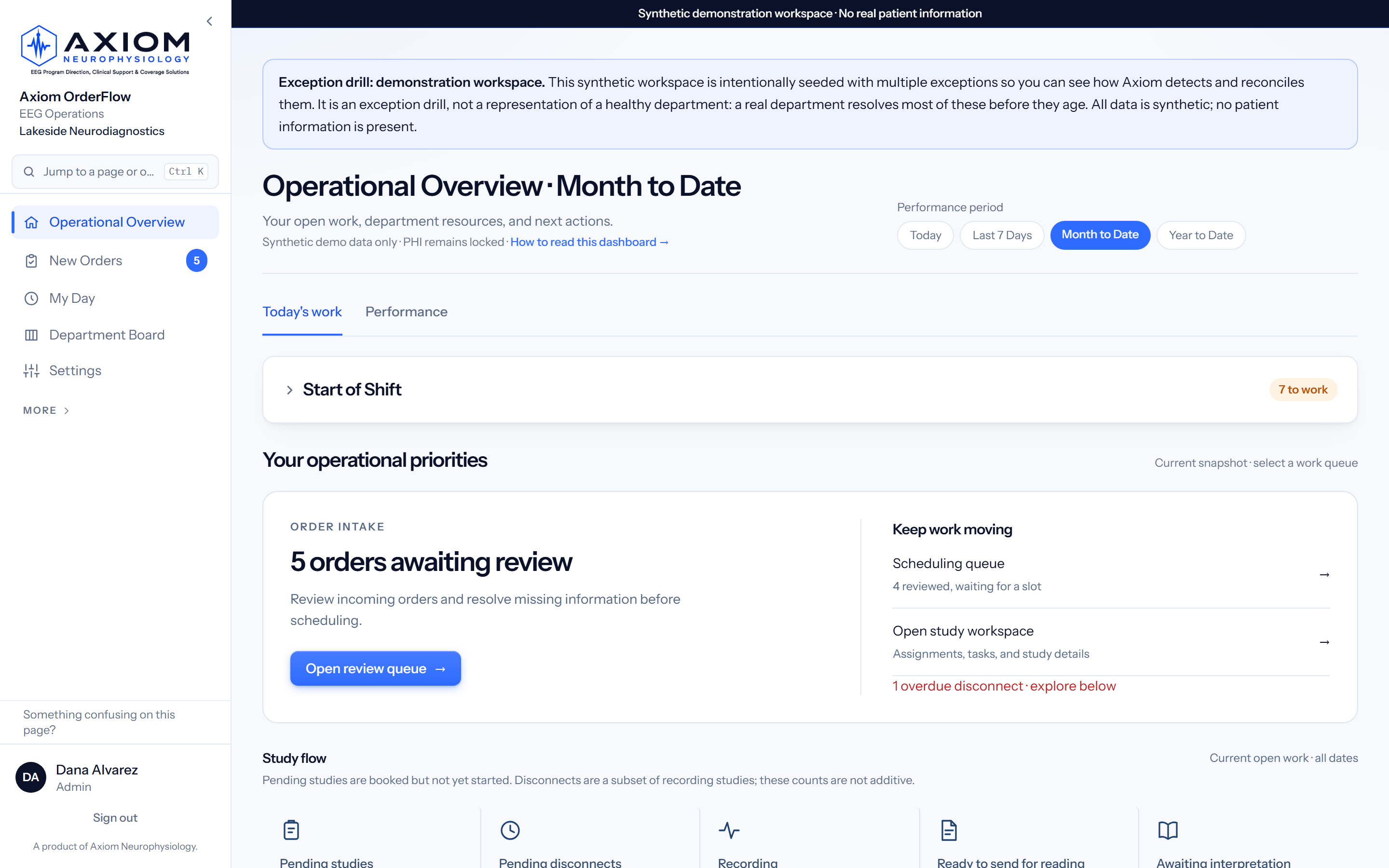
Live product, synthetic demo workspace — no patient information.
Order extraction is the entrance—not the identity. OrderFlow connects the work that follows, from validation and resolution through study operations, reader oversight, billing readiness, and measurable value.
Configured intake channels enter one governed queue with source provenance and a human review boundary.
Staff validate auto-extracted details, resolve deficiencies, assess possible duplicates, and establish scheduling readiness.
Role-aware oversight connects schedules, assignments, studies, readers, equipment, capacity, and daily exceptions.
Recorded work becomes measurable operational outcomes, billing-readiness exceptions, reconciliation context, and executive evidence.
Intake channels, controlled-release modules, identity scope, and interfaces depend on organization configuration and contracted implementation. OrderFlow complements the EHR and does not make clinical decisions.
The EHR owns the clinical record. The acquisition system owns the waveform. Axiom owns the operation.
Axiom OrderFlow coordinates EEG orders, studies, equipment, reader follow-up, and billing readiness. Axiom Shift coordinates the people and coverage behind that work. Connected workspaces link clinical identities, qualifications, availability, and workload. Published availability is reviewed in OrderFlow before it is applied; each coverage view identifies the people and equipment evidence it evaluates.
Axiom does not replace the EHR, acquisition systems, payroll, HR platforms or physician interpretation. It is the operational layer that connects them.
See how governed intake becomes visible ownership, exception resolution, scheduling readiness, study and reader oversight, billing readiness, and measurable operational reporting.
OrderFlow extracts patient and study fields so staff validate exceptions instead of re-entering every detail.
Ownership, readiness, duplicate risk, and next action stay visible across the department.
Supervisors can examine year-to-date studies, workload, staffing signals, equipment, and charge follow-through.
Product film uses synthetic demonstration data only.
EEG work is often divided across order queues, EHR screens, PDFs, inboxes, local trackers, schedules, staffing lists, reading queues, equipment logs, and billing reconciliation. OrderFlow supplies the specialized operating layer between them.
Use conservative numbers from your own intake to estimate the monthly burden of manual entry and tracking.
Estimated manual-entry burden for planning only — not guaranteed savings.
Orders enter through an approved intake channel.
Information is auto-extracted; human validation is required.
Deficiencies, possible duplicates, and exceptions get owned next actions.
Scheduling readiness and operational ownership are established.
Study lifecycle, timing, checks, and equipment remain accountable.
Reader turnaround and unresolved interpretation work stay visible.
Billing readiness and measured outcomes close the loop when configured.
No mockups or concept art — screenshots straight from the live app, running a synthetic demo workspace. No patient information appears in any image.
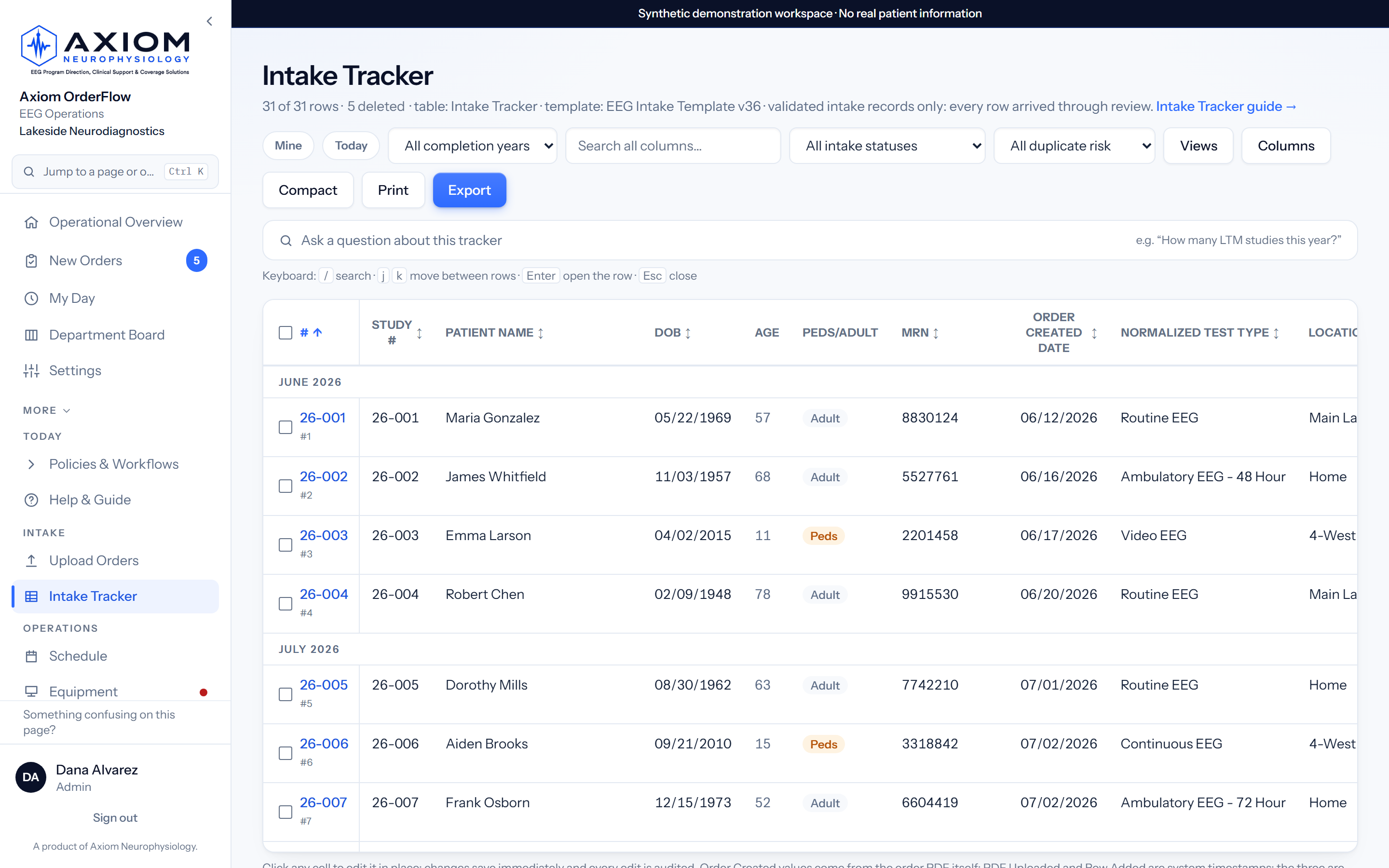
axiomorderflow.com/spreadsheet
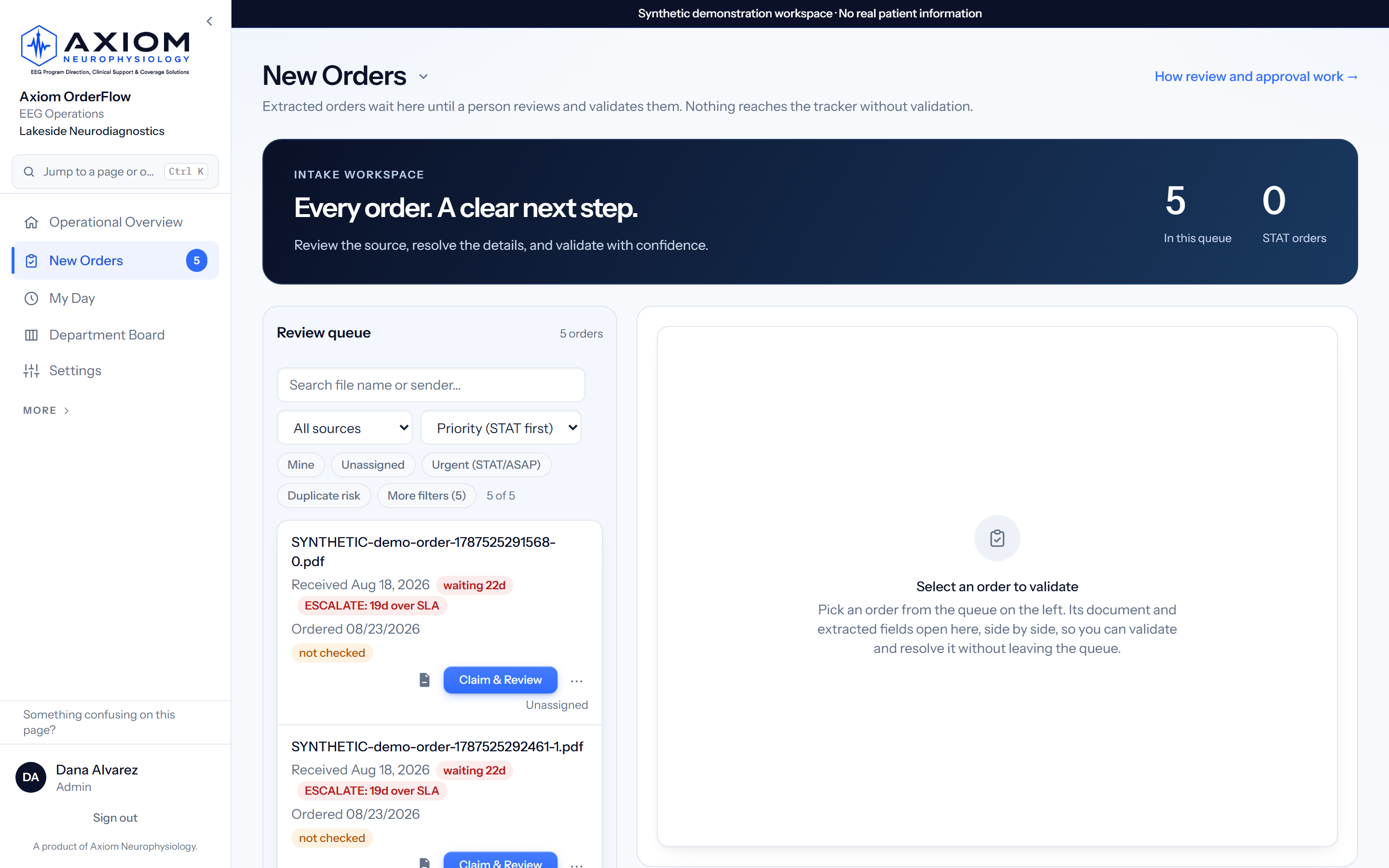
axiomorderflow.com/review
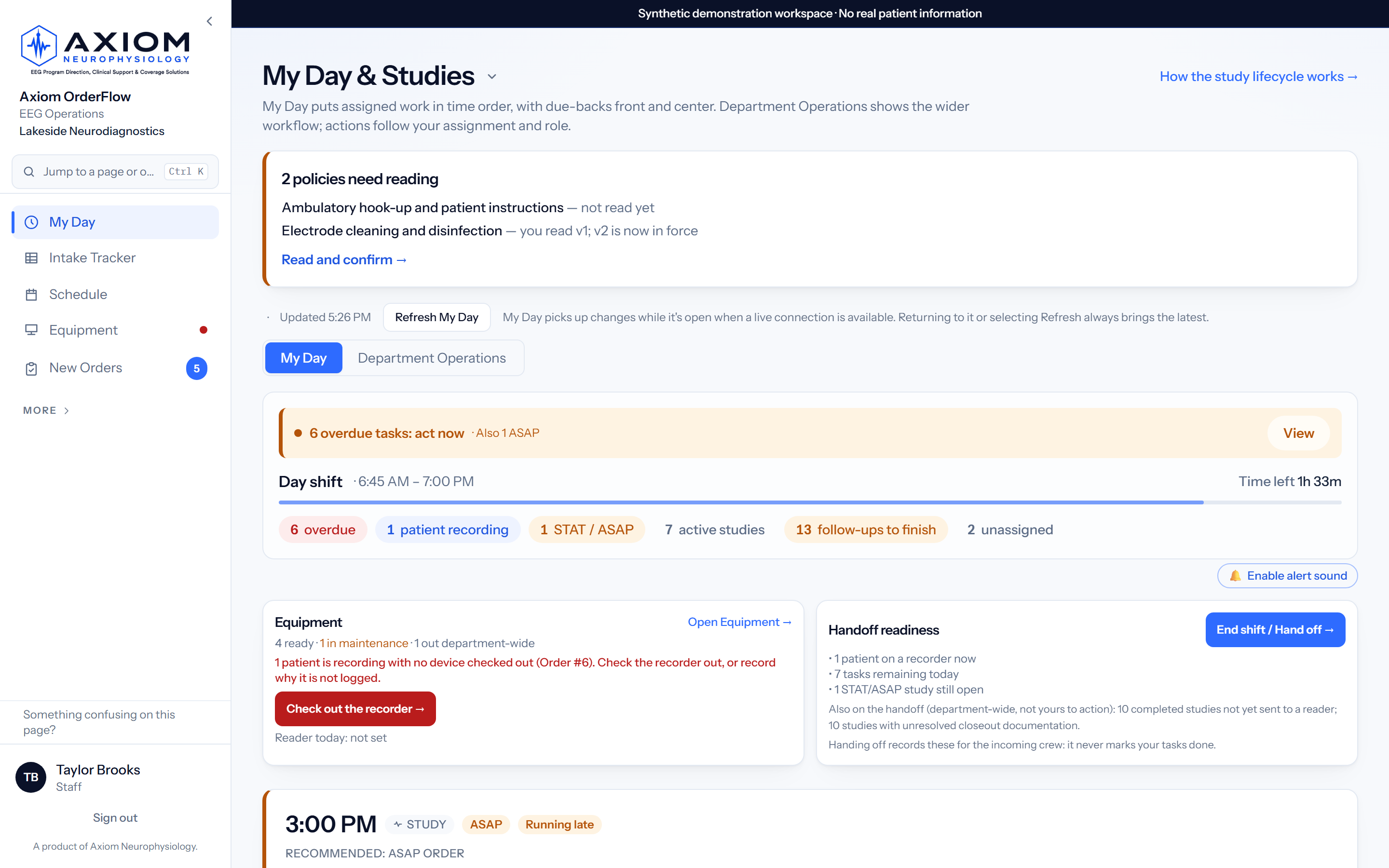
axiomorderflow.com/studies
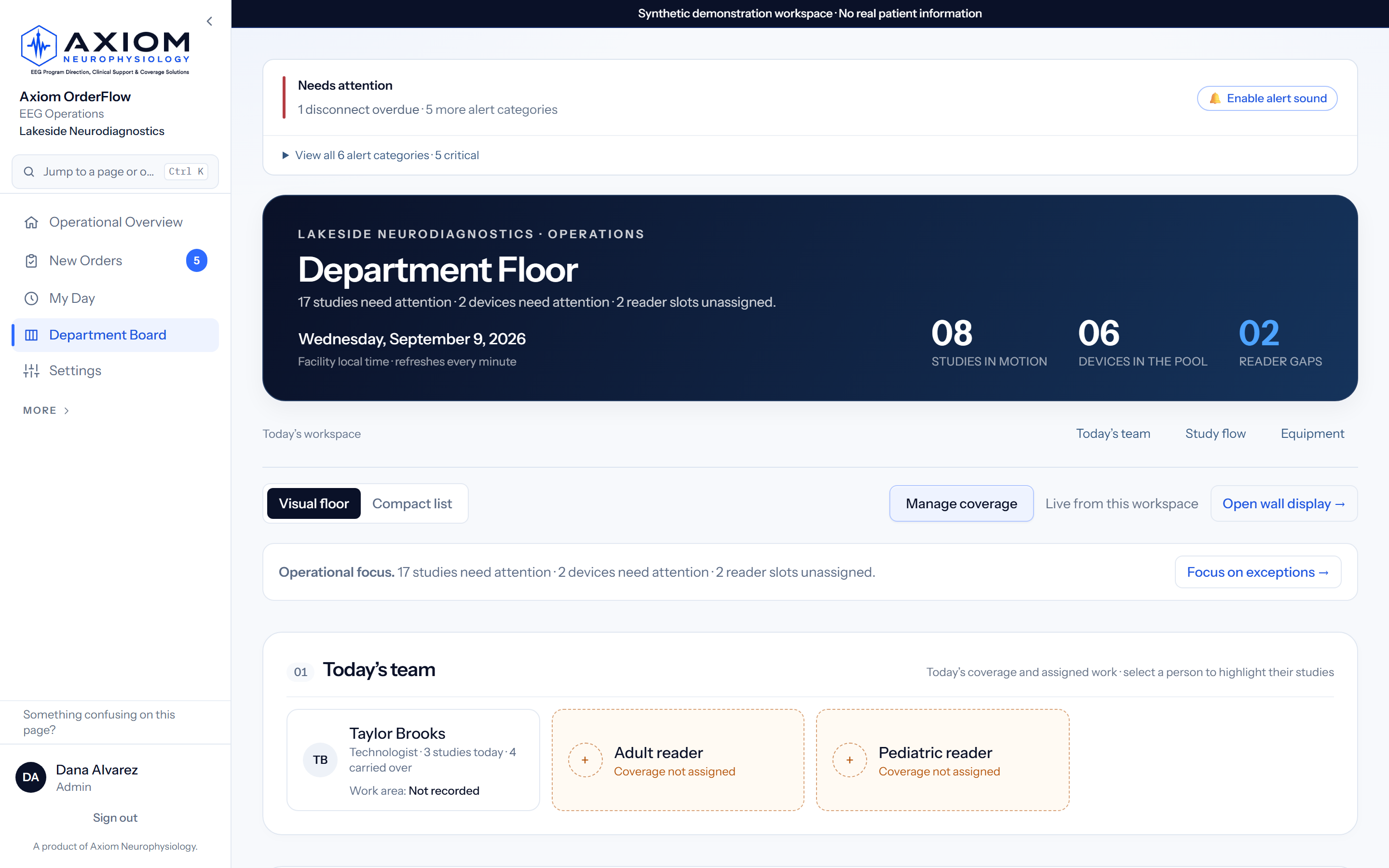
axiomorderflow.com/board
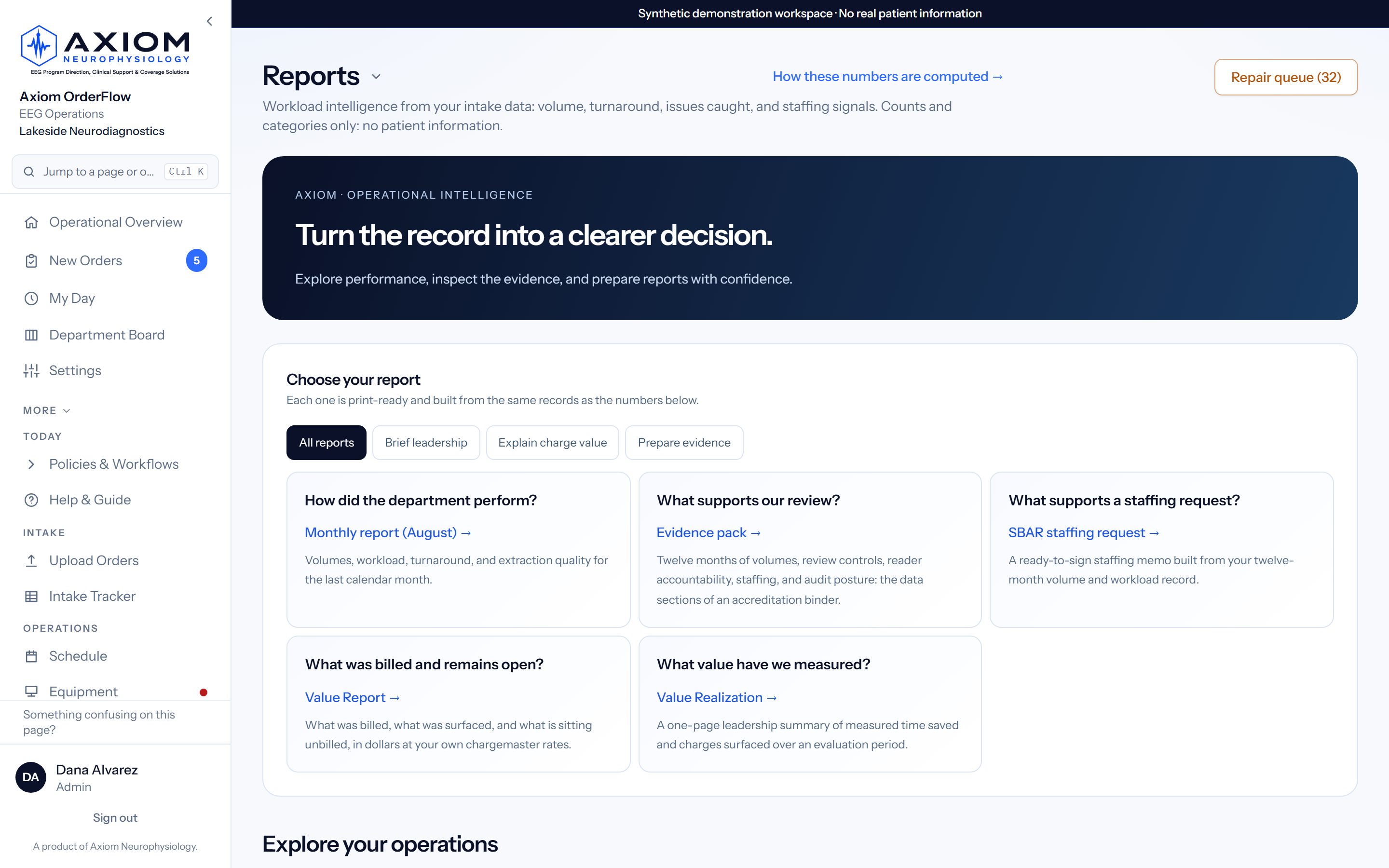
axiomorderflow.com/operations
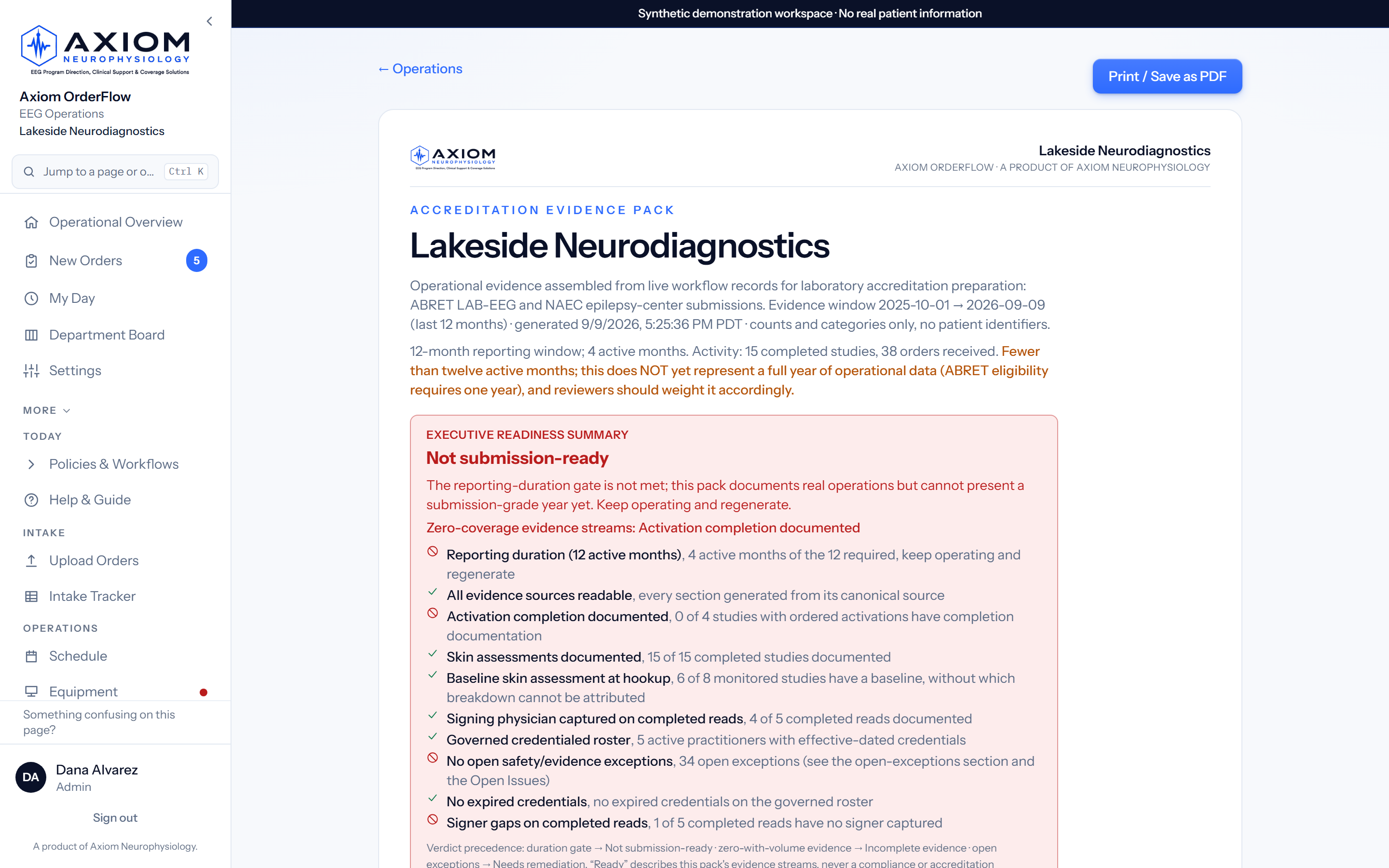
axiomorderflow.com/operations/evidence
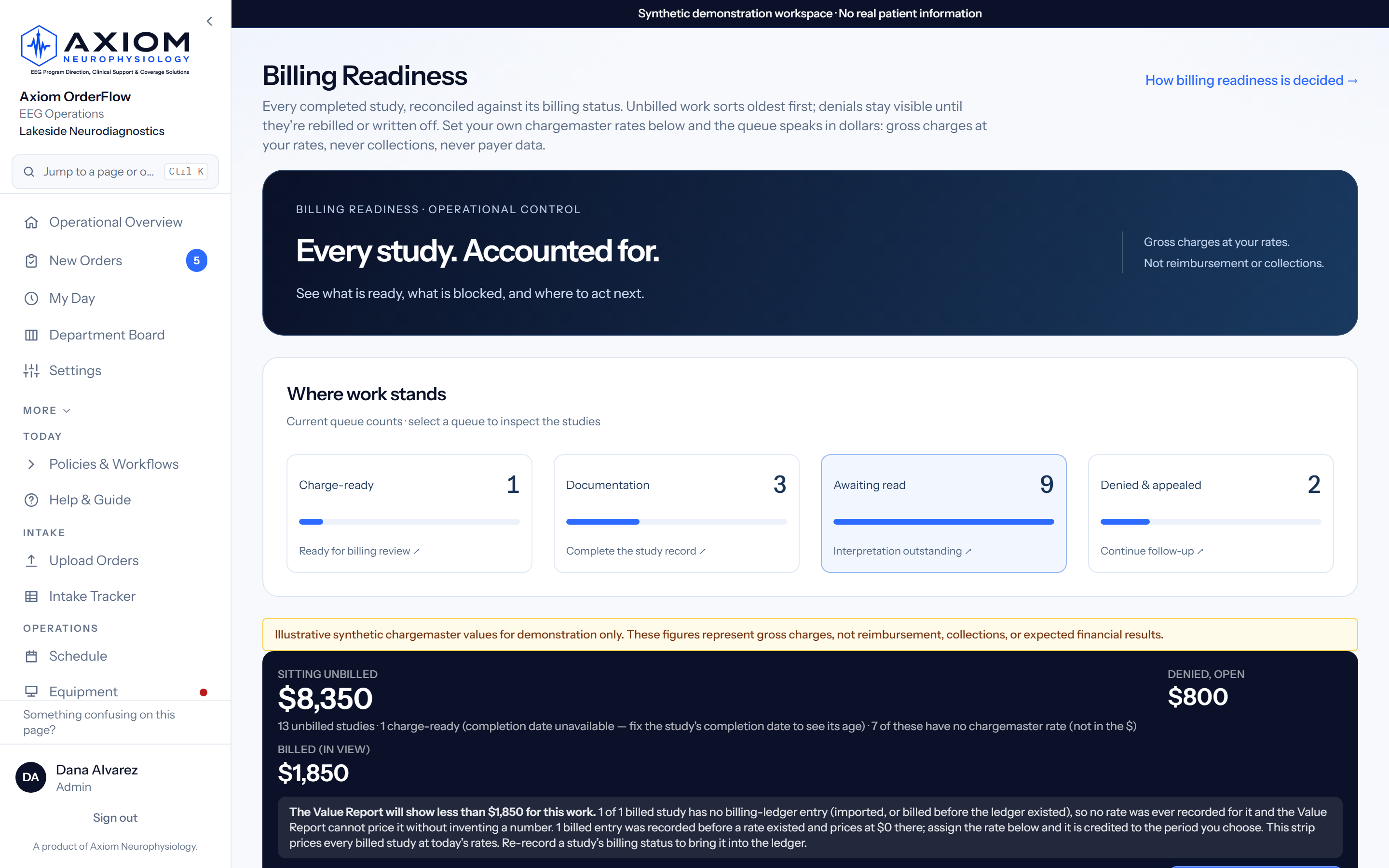
axiomorderflow.com/charges
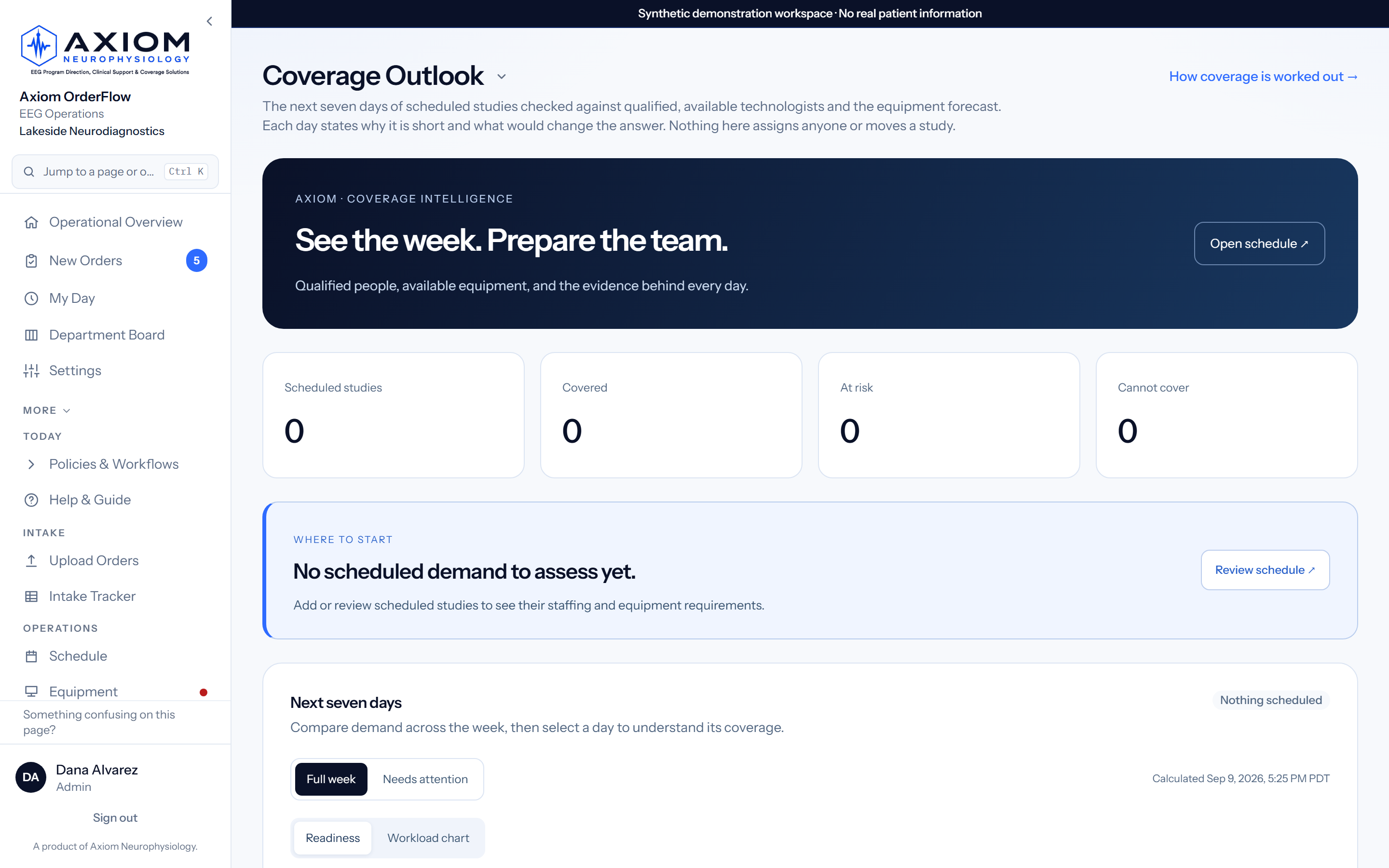
axiomorderflow.com/outlook
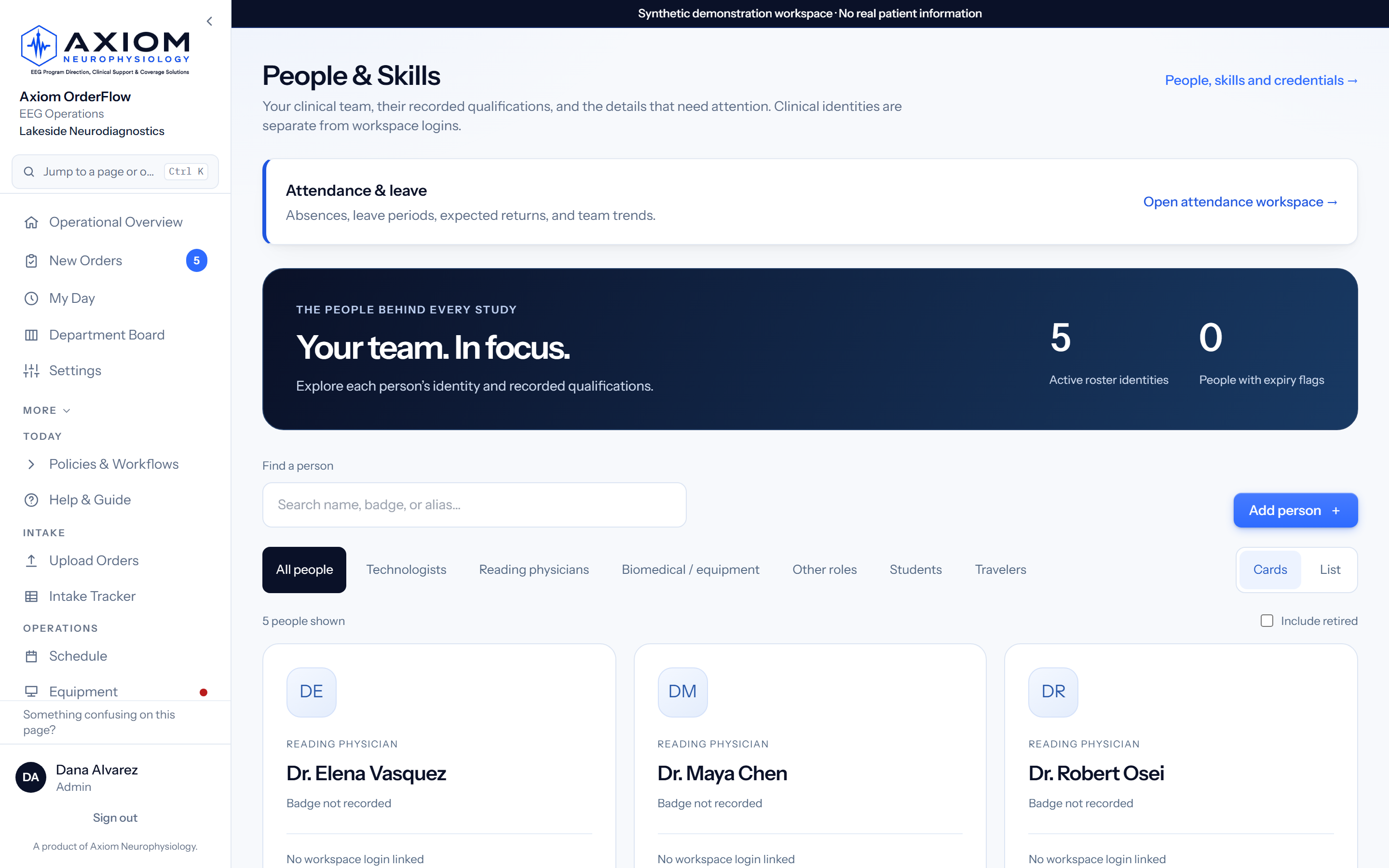
axiomorderflow.com/roster
Extract key patient and order details from EEG order PDFs to reduce repetitive manual entry — native text reading with OCR fallback for scans.
Orders can arrive on their own: point an inbound-email or fax service at your workspace and every PDF lands in the review queue with the sender recorded.
Surface missing authorization details, order dates, and required fields before they slow the team down — STAT orders sort to the front of the queue.
Flag possible duplicate orders for staff review before multiple rows create confusion — exact matches raise a loud warning.
One structured, template-driven tracker: your columns, automatic study numbers (26-001…), month grouping, and plain-English questions answered with receipts.
A time-ordered runlist: hookups at their scheduled times, disconnects due exactly when a wearable study's time is up, daily checks for admitted monitoring.
The dry-erase board, alive: every cart and what it's running, today's disconnects, readers of the day, and unit coverage — refreshing itself every minute. Nobody maintains it.
What the crew on the clock actually did — completed studies, disconnects, hookups, activations, daily checks — for this shift and the one it relieved, on your crew's own start and end times.
Unread studies age visibly — with per-reader pending loads and turnaround, and a Monday summary designed to reach leadership before referrers call.
Pair OrderFlow with Axiom Shift, our technologist scheduler: a schedule published in Shift arrives in OrderFlow as a draft availability batch a supervisor reviews, and Shift reads back per-day study counts (numbers only) so staffing follows the actual workload.
A ready-to-sign hiring memo in the format administration reads — Situation, Background, Assessment, Recommendation — composed from twelve months of volume and workload records.
Nine printed exhibits, each tagged to the ABRET LAB-EEG standard or NAEC criterion it supports, plus a readiness checklist for everything that lives outside the app.
Enter your own chargemaster rates once and the unbilled queue speaks in money: what's sitting unbilled, what's aging, and a printable Value Report of what the system surfaced — gross charges at your rates, never collections.
EEG carts and ambulatory devices with due-back dates — what is out, what comes back today, and what is overdue — checked out against order numbers, never patient names.
The tracker can mirror into Google Sheets, Excel, or SharePoint on its own, plus CSV/XLSX exports in your column order.
The order-created date comes from the order document itself — never the upload time.
Every change recorded in plain English: who, what, old value, new value, and why. Deletions are highlighted and the trail is append-only; original documents follow the workspace's configured retention policy.
“See what requires attention now, who owns it, and what happens next.”
“Find delayed, uncovered, unassigned, or threshold-approaching work earlier.”
“Understand what changed, what is at risk, and what value is being produced.”
“Evaluate tenant scope, human governance, auditability, and implementation boundaries.”
Evaluate OrderFlow through workflow discovery, configuration, synthetic or approved-data testing, staff validation, baseline measurement, controlled launch planning, and an outcome review. OrderFlow pilots are paid, fixed-scope engagements — not free trials — and are separate from Axiom Neurophysiology's 60-day consulting pilot.
Independent neurology clinics and outpatient EEG labs — one location, up to 10 active users.
Fixed monthly subscription + one-time implementation, scoped after an operational assessment. See the commercial model ↗
Hospital EEG departments and clinic networks — unlimited users within the contracted scope.
Fixed monthly subscription + one-time implementation, scoped after an operational assessment. See the commercial model ↗
Multi-site hospitals, regional EEG programs, and health systems.
Fixed monthly subscription + one-time implementation, scoped after an operational assessment. See the commercial model ↗
Commercial scope accounts for facilities, configuration, integrations, implementation, validation, and support. Review the commercial model → No patient information should be entered in demo or pilot environments.
No. OrderFlow is an intake and operations workflow layer. It does not replace Epic, the EMR, facility policy, or clinical oversight.
The current system is used with synthetic or approved test data. Production use with patient information requires completed security review, agreements, and formal readiness steps.
No. It organizes intake information and surfaces missing details. Staff review and confirm everything; it makes no clinical decisions.
It can provide workload and trend data to support staffing conversations as workflow fields are configured.
It flags possible duplicates for staff review, with the matching details shown side by side.
No system eliminates errors. OrderFlow is designed to reduce repetitive manual entry and surface preventable intake issues earlier.
Axiom supports governed HL7 v2 and FHIR R4 interface workflows through a hospital’s interface engine. Each production connection is separately scoped, tested, and accepted with the customer’s interface team. OrderFlow never claims a live EMR connection before it is implemented, tested, and accepted.
Schedule an operational assessment. It maps your intake, study, and billing-readiness workflow and produces a scoped proposal. A paid, fixed-scope pilot follows — it uses synthetic or approved test data to validate fit, implementation boundaries, and measurable outcomes before any production discussion.
Start with an operational assessment of your intake, study, and billing-readiness workflow. A paid, fixed-scope pilot follows to validate fit, staff experience, implementation boundaries, and measurable outcomes.
Do not include patient information in demo requests.
Staffing the team that does this work? Axiom Shift is our coverage-aware scheduler for neurodiagnostic departments. The two now pair as the Axiom Suite: a schedule published in Shift arrives in OrderFlow as a draft availability batch a supervisor reviews, and Shift reads back per-day study counts so staffing follows the workload.